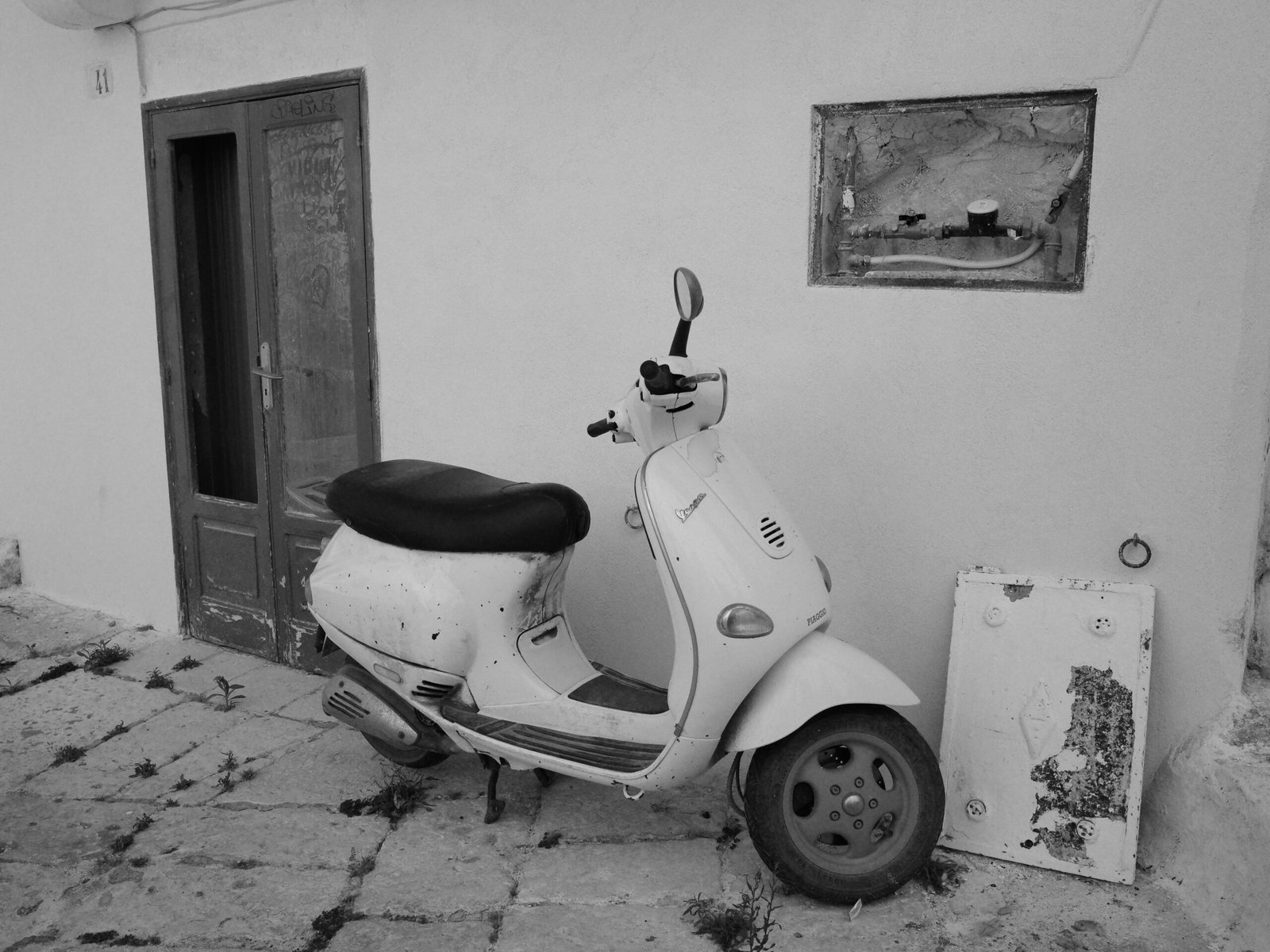
The sun in Puglia does not merely illuminate; it exposes. Rising high over the Valle d’Itria, the blinding Mediterranean light strikes the hilltop citadel Ostuni, bouncing off centuries of hand-applied lime plaster. To the casual tourist, Ostuni is La Citta Bianca—the White City—a picturesque stop on a whirlwind Italian vacation. But to the patient observer, the mind traveling slowly with a camera in hand, Ostuni reveals itself as something far deeper. It is a living, breathing Mediterranean expression of wabi-sabi, the traditional Japanese philosophy centered on finding beauty in imperfection, impermanence, and the natural cycle of decay.
For the mindful traveler, capturing this quiet, transient beauty requires a specific philosophy of looking. It demands an elimination of the superfluous. Walking through Ostuni’s labyrinthine Centro Storico, my visual toolkit was stripped down to the bare essentials: a single, pocket rocket Ricoh GR IV. Stripping away the weight of a heavy camera bag mirrors the minimalist ethos of wabi-sabi. There are no distracting gadgets or massive lenses here—only a tiny, unassuming tool that forces you to be entirely present in the environment, documenting the world exactly as it unfolds.
The Organic Geometry of Puglia’s White City

Wabi-sabi celebrates fukinsei (asymmetry) and kanso (simplicity). Modern urban environments are often built on rigid, artificial grids—monuments to human control over nature. Ostuni is the antithesis of the grid. Its historic center was born out of organic necessity. Streets curve sharply to block coastal winds, arches lean at impossibly slight angles against opposing buildings for structural support, and staircases narrow to confuse ancient invaders.
Wandering these spaces with a wide, fixed 28mm lens allows you to immerse yourself fully in this organic asymmetry. The perspective captures the sweeping, intimate lines of alleys that feel less like streets and more like limestone canyons. Nothing is perfectly square. No two arches match. The walls themselves, coated in layer upon layer of slaked lime wash over generations, possess a soft, human geometry. They feature rounded corners, thumbprints in the plaster, and uneven surfaces. As the harsh midday sun strikes the town, these imperfections transform the blinding light into a beautiful gradient of soft shadows and raw, tactile stone.
Capturing Impermanence: Raw Textures and Urban Decay
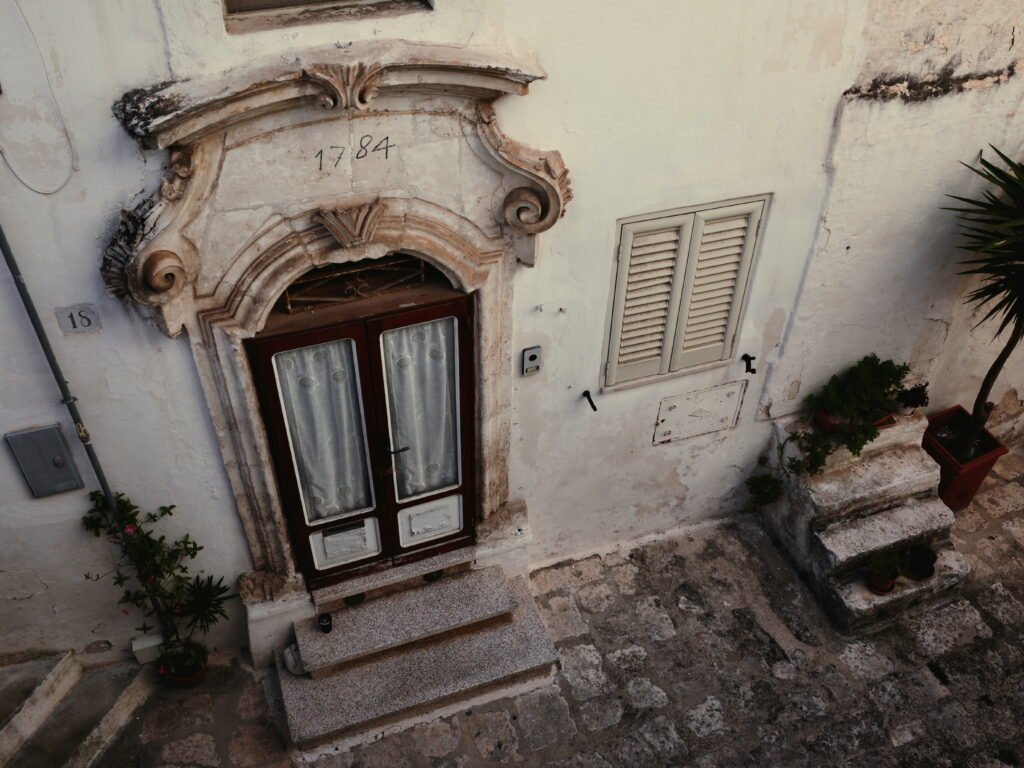
Central to the aesthetic of sabi is the beauty that comes with age—the visible patina of time (koko). Ostuni wears its history openly. Because the city’s whitewash must be constantly renewed to fight the elements, the town exists in a perpetual state of erosion and restoration.
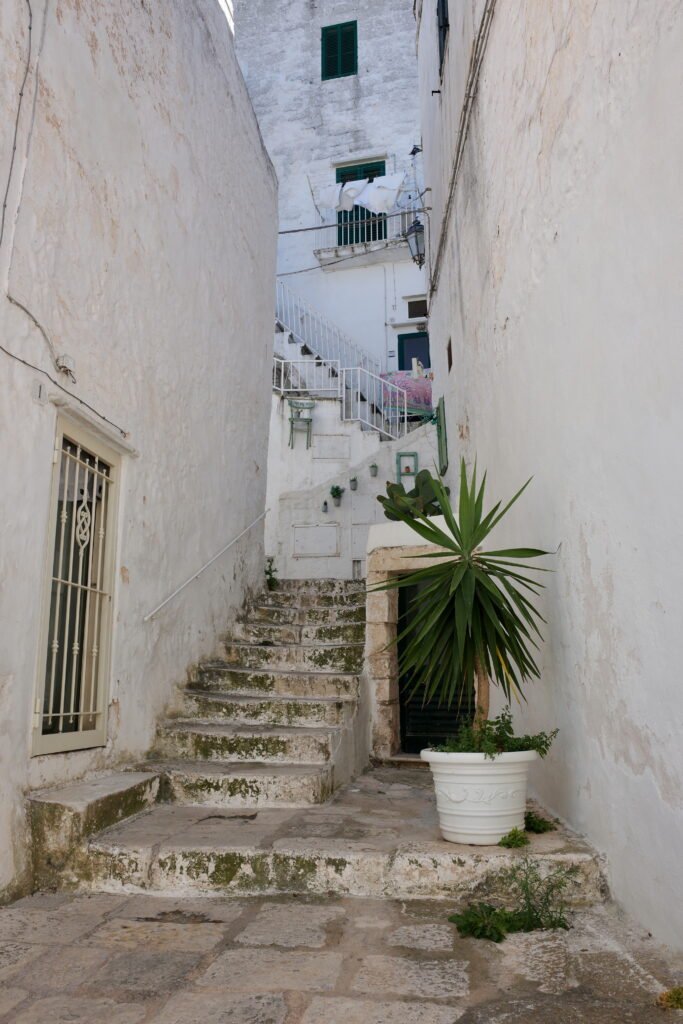

Walking the quietest, residential alleyways away from the tourist thoroughfares, the camera becomes a microscope for this beautiful decay. Through its lens, the peeling turquoise paint of a centuries-old wooden door transitions from a sign of neglect into a canvas of transience. A mindful eye pauses to notice the exposed, golden limestone where the white plaster has chipped away; the oxidized, rusted iron of a Juliet balcony weeping orange stains down a pristine wall; and the green moss taking root in the damp, shadowed crevices of a subterranean staircase.
These elements are not flaws to be cleaned or cropped out. They are the narrative marks of a city surrendered to time. They serve as a poignant visual reminder that nothing lasts, nothing is finished, and nothing is perfect.
The Zen of SOOC: Mindful Photography and Acceptance
Practicing mindful photography means trusting your vision rather than relying on the safety net of digital manipulation. Committing to Straight-From-Camera (SOOC) images—where the photo is completely finished the moment the shutter clicks—forces a profound creative discipline. When you abandon the desire to fix or alter an image later on a computer screen, your relationship with the environment changes. You stop looking at the world as raw data to be edited, and you begin accepting it exactly as it is.

The Ricoh GR IV is uniquely tuned for this meditative process, using built-in film profiles to capture the rich, sun-bleached tones of Ostuni with raw authenticity. The goal of this photo essay is not to present a flawless, clinical reproduction of a popular tourist destination. It is to document the felt experience of the space. By leaving the frames unedited, the authentic grain of the afternoon shade and the true, weathered micro-contrast of the ancient stone remain completely unblemished.
Slow Travel, Quiet Frames

To truly find wabi-sabi in travel, one must decouple from the desire to see everything. It requires sitting on a polished limestone step in a dead-end alley for an hour, watching the shadow of a vine creep slowly across a white wall. It means recognizing that a cracked wall or a discarded, rusted scooter leaning against a medieval arch tells a more profound story about life in Puglia than a postcard-perfect view of a cathedral.

Ostuni invites us to slow down, to strip away our expectations, and to look through a more mindful lens. Through a minimalist approach to photography, we can document the quiet, unpretentious intersections of human life and natural decay, finding peace in the weathered corners of the world.

The Mindful Lens Toolkit
Finding wabi-sabi in the corners of the world requires stripping away the unnecessary. If you are inspired to slow down your own creative process, explore The Curated Resource Collective. Discover our field-tested insights on the minimalist Ricoh GR camera system, alongside a handpicked library of recommended books dedicated to mindful photography, slow travel, and intentional living.
Leave a Reply